If a clinic in Korea asks to photograph your face, ask two questions before the camera comes out. What will the picture be used for, and who will be able to see it? A surgeon may want a consistent record for planning or follow-up. A public before-and-after gallery, an advertisement, a teaching presentation and your private chart all have different audiences. Ask the team to point to the part of the form that covers each use.
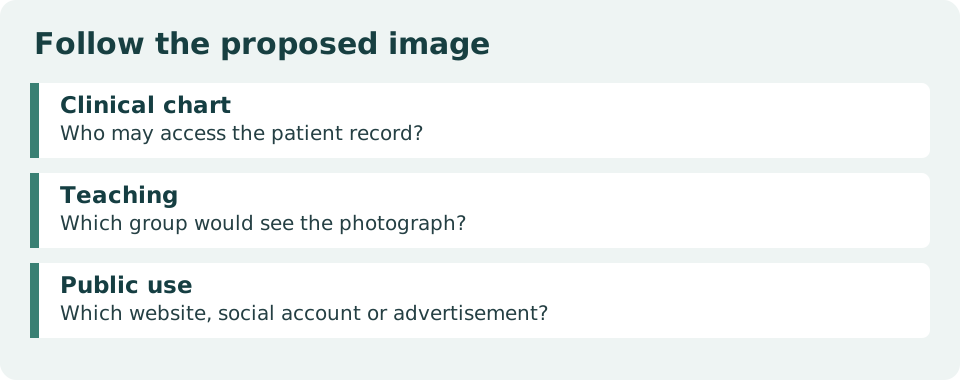
Imagine where you might see the picture
A closely cropped nose may feel anonymous when you see it on the clinic’s screen. Now imagine the same image next to a procedure date, a quotation from your review and a description of your trip. Would someone who knows you recognise the combination? Is there a tattoo, piercing, distinctive hairline or another detail you would want removed? The American College of Surgeons advises surgeons to protect patient identity on social media and specifically highlights identifying details such as facial features and tattoos.[1]
Ask to see an example of the proposed crop without requesting another person’s private records. You might prefer to demonstrate with a sketch. One simple way is to draw a rectangle around the area you feel comfortable discussing. Ask how the front, side and angled views would differ. A crop that conceals an eye in a frontal image might leave a recognisable profile in another view.
If a video is planned, listen for other identifying information. Ask whether it includes your voice, a conversation with the interpreter, a view of your companion or text identifying where you stayed. A silent series of images and a narrated account of your procedure create very different records. Make sure you and the team are talking about the same thing when someone says “a few shots.”
Follow one image from camera to audience
It can help to choose one proposed use and discuss it from start to finish. Suppose a staff member says the photograph may be used for education. Ask who the audience is. An image reviewed in a private consultation with you has a different audience from a lecture attended by clinicians. A recorded lecture placed on a public account has a different audience again. Explain which uses you are comfortable considering and which require more time.
Now imagine the image is intended for the clinic’s own website. Ask whether it may also appear in social posts, a paid advertisement, a partner directory, translated materials or the personal account of someone working at the clinic. You can write down the answer in your preferred language and ask the clinic to confirm it. If the written permission is broader than the explanation, ask for the discrepancy to be resolved before making a decision.
Finally, ask about time. How long would the material remain visible? Is the clinic proposing a single publication or ongoing reuse? Would a later procedure make an older photograph available for use again? If the use is open-ended and you would prefer a shorter period, ask whether the clinic can offer that choice. You can take home the wording and consider it at your own pace.
When a discount depends on being photographed
If there is a reduced price connected to photographs or a patient story, ask for two written offers. One should explain the cost and care arrangements at the ordinary price. The other should explain the amount, required photographs, appointments and publication conditions attached to the lower price. Compare them when you have privacy and time to think.
A headline discount may tell you very little about the practical commitment. Would you have to return to Seoul for follow-up photography on specific dates? Who pays for accommodation or travel if the timing changes? Must you appear in videos or answer interview questions? Does the offer depend on your attending every session, and what would happen if illness made that impossible? Ask for answers before paying. The issue is whether the arrangement fits your life, including your comfort with being seen.
You might decide that the ordinary price gives you the privacy you want, or you might decide against treatment altogether. You can also ask whether the clinic has another option. Discuss clinical suitability separately with the treating clinician. Agreeing to photograph a procedure cannot determine whether you would benefit from it. Japan’s Consumer Affairs Agency encourages patients considering cosmetic treatment to understand the risks and options and consider whether they need to decide immediately.[2]
Ask about the images your clinician needs
Talk with the clinician if you are comfortable with treatment but uncertain about photographs needed for care. Ask which views help with assessment, what clinical question they answer and how they will be stored. If declining some photographs changes what the clinician can safely assess or monitor, ask for an explanation specific to the proposed treatment. Avoid assuming that every photograph is optional or that all photographs have to be made public.
If another clinician will provide follow-up after you travel home, ask how relevant clinical images can be shared privately with your permission. Check whether your usual practice can receive them. A copy in your possession may be convenient, but you should know how to store and transmit it without unintentionally sharing it with a family album or a group message.
A companion can help by asking you what you understood after the visit. The clinic should still speak directly to you. Ask for enough quiet time to read the terms and use an interpreter where needed. A translated clinic homepage does not establish that the consent discussion or the contract will be available in your language. Ask in advance which parts can be explained, which documents are translated and how you can obtain a copy.
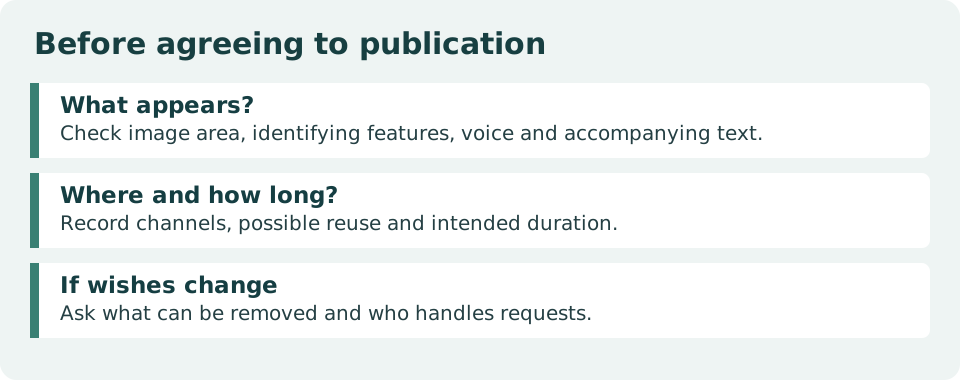
What happens if you later change your mind?
Before signing, ask for the contact route for changing your preferences and what action the clinic can take at each stage. There may be a different answer before photographs are taken, after they are stored, once a post has been prepared and once it has appeared publicly. Ask whether future use can be stopped and what happens to posts the clinic controls. Do not assume the same answer applies to all of those stages.
Someone viewing a public post may save or share a copy. A request to the original publisher can address its own use, but it cannot reliably collect every copy another person has made. If complete removal in the future is essential for you to feel comfortable, discuss that concern while the decision is still yours. The clinic should be able to explain the limits of the promises it makes.
If you later see an unexpected use, keep a private record of the address, date and where the picture appeared. Retrieve your copy of the agreement. Write to the clinic through its designated channel and specify what you saw, what you understood you had agreed to and what action you are requesting. Avoid reposting the image publicly as evidence if your aim is to limit its circulation. The process and remedies available depend on the circumstances and applicable rules.
A conversation you can practise
Start with an ordinary sentence: “I would like to understand what happens to my pictures before I decide.” Ask the person explaining the form to show you separately where it discusses photographs for clinical records and where it discusses any additional uses. Next, explain your own boundary in plain words. For example, you might be comfortable with private clinical documentation and want a separate conversation before any public use.
Read back the specific points you agreed. Can the image be used with your name? With a clinic-generated alias? Can it be shown to another patient in a private room? Can it be displayed at a later appointment as part of a gallery? Does the clinic have permission to use the same picture in another language? You need only ask about uses that matter to you, but an example often reveals differences hidden by a broad word such as “sharing.”
If an answer remains unclear, write down the exact question. Find out which staff member can resolve it and how they will reply. You may prefer to have the final discussion without a companion or to include someone you trust. The purpose is to hear the full explanation and decide for yourself without a visit schedule or a price offer making the choice on your behalf.
A listed clinic to contact
Gangnam Natural Beauty lists Answer Plastic Surgery in Seoul. Its international website presents facial procedures and has a Before & After section, making it a relevant clinic for a question about patient photography. The existence of that section establishes neither its policy for your photographs nor what would be required for your care. Ask the clinic to explain its current options in writing before agreeing to photographs. Visit Answer Plastic Surgery’s international website.
Keep one copy you understand
Leave the consultation with the agreement you actually reviewed, its date, your selected options, the contact for future questions and any translated explanation you relied on. If you chose to postpone the decision, record which permission is still open and when the clinic expects an answer. A note in your own words can help you remember the conversation, especially when several treatments were discussed.
At home, try one final test. Can you tell someone who will see your photographs, for what purpose, for how long, and what you can do if your wishes change? Check any gap with the clinic before committing. It is much easier to clarify a sentence while an image is private than to discover later that you and the person publishing it understood that sentence differently.
[1] American College of Surgeons, Guidelines for the Ethical Use of Social Media by Surgeons. https://www.facs.org/about-acs/statements/guidelines-for-the-ethical-use-of-social-media-by-surgeons/
[2] Consumer Affairs Agency, Japan, 美容医療を受ける前に確認したい事項と相談窓口について. https://www.caa.go.jp/policies/policy/consumer_policy/information/information_002