A short trip can make a long treatment menu tempting. Some aesthetic procedures can share an appointment in selected patients, but there is no universal safe combination of laser, filler, botulinum toxin and skin boosters. A useful plan explains what each procedure adds, why its timing fits the others, and how the clinician will assess you before you leave Korea. The right outcome may be one treatment now and a separate decision later.
Start with the problem, not the package
Write your main concern in ordinary language: persistent redness, a hollow that creates a shadow, or lines that appear when you frown. Then write what you want to preserve, such as your expression, facial proportions or ability to return to work comfortably. These details make a consultation more useful than arriving with a list copied from a promotional package. They also help you notice when several proposed treatments are being offered for different problems you do not actually want addressed.
Ask the doctor to match each recommendation to a specific finding. If a second procedure is optional, request the expected additional benefit in words you can understand. “Better skin” is too broad to compare against extra cost, discomfort and recovery. Ask what the likely result would be if you stopped after the first intervention. A plan that still makes sense without every add-on gives you a clearer choice. The AAD’s consultation questions emphasize goals, risk tolerance and procedure-specific experience.
Why the names on a menu are not enough
Laser, radiofrequency, ultrasound, filler and toxin are not interchangeable categories. A laser uses light; radiofrequency uses electrical energy to generate heat; ultrasound uses sound energy. Even within a category, treatment settings, depth and the intended target differ. A phrase such as “laser lifting” may not tell you which technology is actually proposed. Request the device name and the exact procedure rather than relying on the package title.
Injectables also need to be identified. Botulinum toxin acts on muscle activity; filler adds material to tissue; “skin booster” describes a broad marketing group rather than one standardized product. A compatibility statement about one hyaluronic-acid filler does not establish compatibility for every injectable marketed alongside it. Read our skin booster guide if the formulation is unclear. Keep a written list of proposed products and ask the clinician to check the complete list together, including procedures booked at other clinics.
What the evidence can—and cannot—tell you
A 2019 review and expert consensus considered hyaluronic-acid fillers with light and energy treatments. It described limited evidence, often from small or nonrandomized studies, and its recommendations focused on particular branded fillers. That is much narrower than proof that any laser and any injectable can safely be combined. Its advice should not be converted into a universal timetable or a do-it-yourself treatment sequence. See the published review and its limitations.
Clinicians also describe different approaches to ordering selected treatments. An AAD meeting report discusses individualized multimodal plans, distinguishing selected nonablative combinations from procedures associated with more swelling or skin disruption. Variation between expert approaches is a reason to ask about the exact combination, not to choose whichever sequence fits your sightseeing schedule. Ask whether the rationale is based on product instructions, clinical studies, professional experience or a mixture of these.
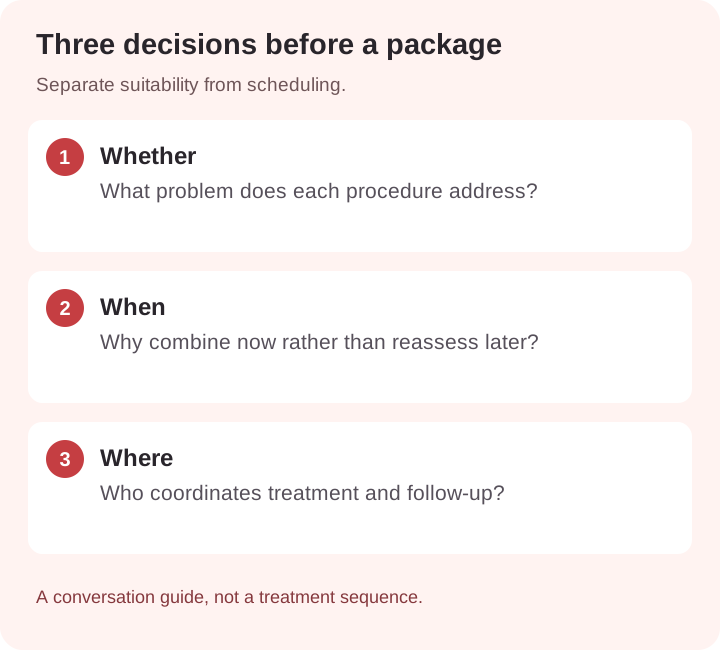
Use three separate decisions: whether, when and where
First decide whether both treatments are appropriate. Next decide whether they should be done together or staged. Finally decide where each will be delivered and who owns the follow-up. These are different decisions. Agreeing that two procedures might help does not commit you to doing both on the same day. Similarly, a clinic offering both services does not establish that both are suitable for you.
For a staged plan, ask what the doctor wants to observe before making the next decision. Is the review intended to reassess the original concern, inspect healing, or decide whether the second procedure remains necessary? A review should have a purpose beyond collecting another fee. Record what would lead to proceeding, changing the plan or stopping. If the review cannot happen during your stay, discuss whether treatment should be deferred or whether suitable local follow-up can be arranged before you travel.
Previous treatments belong in the same conversation
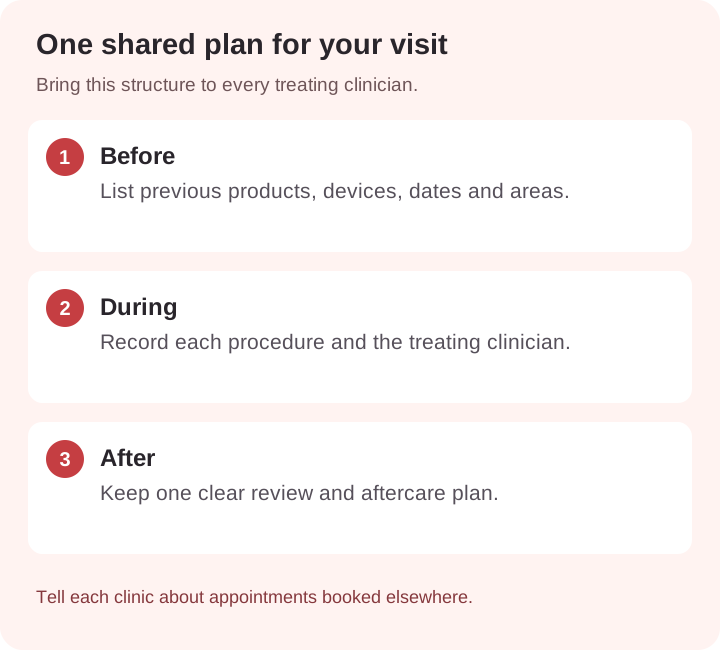
Tell every treating clinician about earlier filler, threads, implants, surgery and energy procedures, including treatments performed outside Korea. Bring the original records if you have them. If you do not know a product or date, say so. An honest gap in the history is more useful than guessing that a material has disappeared because the effect looks less visible. Ask the new clinician which missing information is important enough to obtain before proceeding.
Prepare a simple record with the date, anatomical area, procedure, product or device, treating clinic and any reaction. Include your medicines, allergies and relevant medical conditions separately. Do not stop a prescribed medicine to make a cosmetic appointment possible without speaking to its prescriber. A coordinator can collect the records, but the clinician planning treatment needs to review them. Our medical-records guide explains what to keep after the new appointment as well.
Ask what could make the appointment change
The plan made online should remain provisional until you are assessed. Ask what findings could lead the doctor to cancel an injection, change a device treatment or recommend medical care first. A flare, suspected infection or an unexplained skin change should not be forced into a prepaid timetable. Ask about the financial consequences of a clinical decision not to proceed before paying a nonrefundable package fee.
Be especially careful when an invasive treatment is presented as a casual add-on. In its October 2025 safety communication, the FDA described reported serious complications with certain uses of RF microneedling, including burns, scarring, fat loss and nerve damage. This is a medical procedure with its own risk discussion, not simply an extra facial step. The FDA communication is US guidance; it does not establish Korean approval status for a particular device or use.
Plan for recovery as a whole experience
Ask how the combined plan affects cleansing, makeup, sun exposure, exercise and any planned massage or facial. Request one coherent set of written instructions rather than separate leaflets that might conflict. If one treatment’s aftercare appears inconsistent with another’s, ask the clinician to resolve the issue before treatment. Do not improvise by choosing the less restrictive instruction. The record should specify whom to contact if you are uncertain after returning to your accommodation.
Distinguish being able to leave the clinic from being ready for a wedding, a long flight or an important photograph. Ask about expected visible changes, possible complications and the point at which the result can be assessed fairly. Recovery is not necessarily the simple sum of the shortest advertised downtimes. Avoid booking a demanding activity immediately after a combined appointment until the treating team has explained whether it fits your individual plan.
One trip does not need one crowded treatment day
Build the itinerary around consultation, treatment and review as separate commitments. List your actual departure time, not just the departure date. Tell the clinic whether you are travelling alone and whether you could extend your stay if necessary. You can ask for a consultation-only appointment before committing to the rest of the visit. This preserves the option to compare advice or decide that the proposed benefit is not worth the practical burden.
If you book at more than one clinic, tell both teams the complete plan. Do not assume a booking platform automatically shares clinical records. Ask which clinician should coordinate decisions when recommendations overlap. Two individually reasonable plans can still be difficult to interpret when neither doctor knows what the other has done. Keep enough flexibility to cancel the second appointment if the first clinician advises that further assessment or healing is needed.
Compare the core plan and the optional additions
Request an itemized quote showing consultation, each intervention, follow-up and any required aftercare products. Ask whether an unused component can be removed if the doctor changes the plan. Clarify whether the quoted amount includes tax and whether later reassessment carries a separate fee. No single package price can tell you whether a combination is medically sensible. The comparison becomes useful only when you know what you would actually receive.
Write down the one treatment you would choose if you could only have one. Then ask the doctor whether that choice matches the main problem. This is a practical way to separate priority from enthusiasm. It also makes room for no procedure at all if the likely change is small or the follow-up is impractical. Read the cost-comparison guide for a format you can use when different clinics quote different combinations.
Recommended listed clinics for a combination consultation
These are commercial partner listings selected because their current official menus include relevant treatment categories. Placement is not a ranking of clinical outcomes. The useful next step is an assessment of your particular combination, rather than booking every service shown.
BLS Clinic Main Branch lists laser treatment, lifting, skin care, boosters and volume treatments on its international website. That range makes it relevant when you want one consultation to compare approaches. Ask which treatment addresses your first priority, whether another adds enough benefit, and who will coordinate review. Confirm the main branch when enquiring; a service listed by a clinic group should not be assumed available from every doctor or location.
Beauty Story Clinic lists medical skincare and injectables alongside lifting treatments. Its official service page identifies Dr. Seo Binna as the lead physician for this area. You can review the doctor profile and ask how an injectable proposal would be coordinated with a device treatment. The service range supports discussing a plan; it is not proof that any proposed pairing is suitable or that all procedures should share an appointment.
Questions patients often ask
Can laser treatment melt my existing filler? A general yes or no is unreliable. The clinician needs to know the filler, placement, energy device and proposed settings. The combination review above has important limitations. Bring your records and request an explanation for your exact situation instead of treating a social-media claim as a treatment rule.
Is separating treatments always safer? Not automatically. Staging may help with assessment or logistics, but it does not remove each procedure’s risks. Ask what the proposed interval is intended to accomplish and what findings the doctor needs to see before continuing. There is no interval in this article that substitutes for that decision.
What if I only have a few days in Seoul? Make that constraint clear before paying. Ask what can reasonably be assessed and followed up, and what should wait. A smaller plan or consultation-only visit may fit better. Your available holiday time is a constraint on the treatment choice, not a reason to compress clinical decisions.