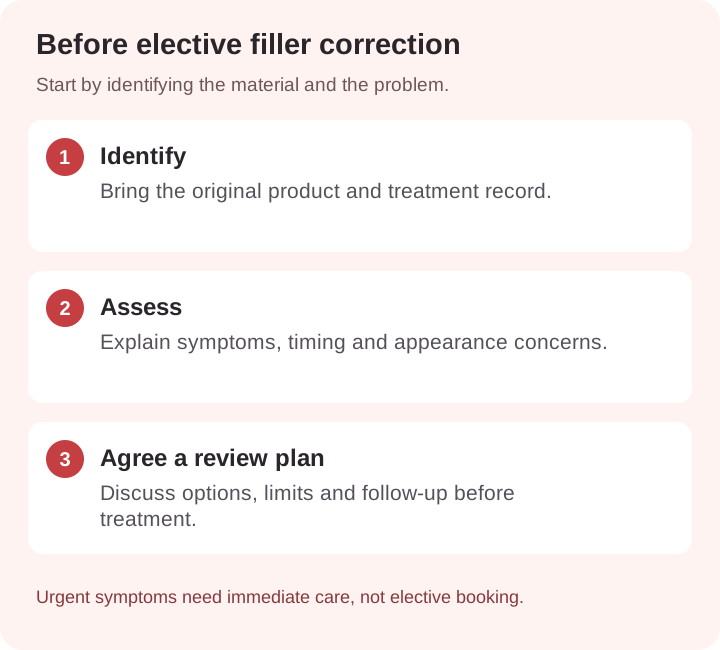
If you are unhappy with filler, the first step is to identify what was injected and what is causing the concern. Hyaluronidase can be used by clinicians to break down hyaluronic-acid filler, but it is not an undo button for every injectable or every complication. A planned correction requires assessment, a discussion of alternatives and follow-up. Sudden visual symptoms, unusual pain or concerning skin-colour changes after an injection require immediate medical attention, not a routine cosmetic booking.
Distinguish an appearance concern from a possible emergency
An unwanted shape and a time-sensitive complication are different situations. The FDA advises immediate medical attention for unusual pain, vision changes, white, grey or blue skin near an injection site, or stroke symptoms during or shortly after filler treatment. Do not wait for a flight to Korea, a photograph review or a routine appointment if these occur. Tell the emergency team that you have had filler and provide the treatment details if available. See the FDA’s patient guidance.
Not every important problem starts immediately. A newly painful, hot, red or enlarging lump needs prompt clinical assessment, even if the injection happened some time ago. Those features alone do not tell you whether the cause is infection, inflammation or something else. Do not assume that dissolving is automatically the right response. The review of delayed-onset nodules explains why a working diagnosis matters. Online appearance comparisons cannot establish that diagnosis for you.
Find out which material was used
Ask the original clinic for the product name, injection date, treated areas, amount and any available batch details. “Filler,” “collagen injection” and “volume treatment” are not sufficiently precise descriptions. Hyaluronic acid is different from calcium hydroxylapatite, poly-L-lactic acid and permanent materials. The FDA notes that removal can be difficult or impossible, particularly with some non-hyaluronic-acid or permanent fillers. Do not book an enzyme treatment on the assumption that all products respond alike.
Bring records from every relevant clinic, not only the most recent visit. If several materials may have been used, tell the assessing doctor. An older injection can be relevant even when you no longer notice its original effect. If records cannot be obtained, be clear about what is known and what is uncertain. The doctor can decide whether further investigation is useful before proposing treatment. Our records guide provides a format for organizing this history without relying on memory alone.
What hyaluronidase actually offers
Hyaluronidase is an enzyme used in aesthetic practice to break down hyaluronic acid. Its role includes selected elective corrections and management of certain complications, but those situations require different clinical decisions. It is not a treatment you should buy or administer yourself. The product, indication, treatment approach and monitoring belong with a qualified clinician. The professional hyaluronidase guideline also discusses formulation differences and allergic reactions; the fact that a substance has a medical use does not make it risk-free.
A discussion about reducing filler should identify the intended endpoint. Do you want a small visible area reassessed, a broader volume change, or evaluation of a persistent symptom? These are not interchangeable requests. Ask the doctor what can reasonably be changed and what cannot be predicted precisely. “Restore my exact original face” is not a result that can be promised. Your appearance before treatment is useful context, but it is not a specification that an injection can reliably reproduce.
A lump is a finding, not a complete diagnosis
A clinician may need to distinguish product placement from swelling, inflammation, infection or another cause. The history, examination and pattern of symptoms matter. Depending on the concern, investigation may include imaging or other tests. A 2024 consensus on late-onset reactions describes several possible causes and individualized management. Its clinical algorithms should not be used as home treatment instructions. The useful patient question is: what diagnosis are we treating, and how confident are we about it?
Ultrasound may help identify the location of filler and assess complications when performed and interpreted by an appropriately experienced clinician. It is not automatically required for every consultation and does not guarantee that every uncertainty will disappear. The published ultrasound literature review describes its diagnostic role. Ask whether imaging would change the proposed plan, who would perform it and what happens if the findings are inconclusive. Do not assume a clinic offers imaging simply because it offers filler.
Prepare a concise story for the consultation
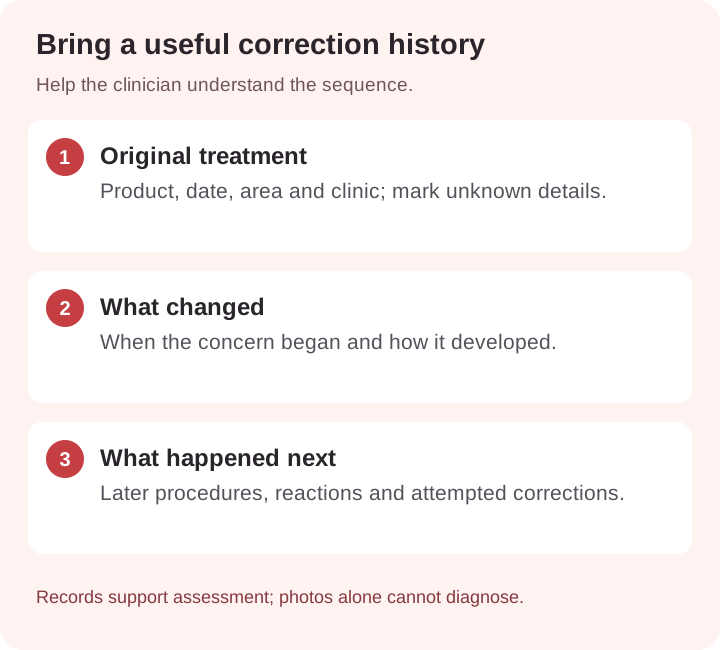
Write down what was done, when you first noticed the concern and how it has changed. Separate appearance from symptoms. For example, record whether you dislike the contour, feel a lump, notice intermittent swelling or have pain. Include previous attempts to correct the issue and how you responded. This helps the doctor understand the sequence without needing to reconstruct it from a collection of messages and photographs during a short appointment.
Bring unfiltered photographs from before treatment and from different stages afterward if you have them. Similar lighting and camera position make them easier to interpret. Explain which image reflects your concern rather than expecting a doctor to infer it from a heavily edited selfie. Do not repeatedly press, manipulate or experiment on the area to make a photograph more convincing. Ask the clinician how best to document any changes between appointments and how those images should be sent securely.
Discuss alternatives before agreeing to dissolve
Depending on the diagnosis, options may include observation, a planned reassessment, treatment directed at a complication, elective reduction of suitable filler, or referral for further evaluation. The right choice depends on more than whether an enzyme is available. Ask what would be expected if you did nothing for now and what findings would change that advice. Observation should come with a review plan, not leave you unsure about when to seek help.
If the concern is mainly cosmetic, explain what you want to preserve as well as change. Ask whether the proposed treatment could reduce a feature you currently like. Discuss how the clinician will decide whether another session is warranted, and whether the uncertainty is acceptable to you. You do not have to agree to correction during the first appointment. The NHS’s pre-procedure guidance encourages careful consideration of expectations and the possible impact of an unwanted outcome.
Ask about risks without requesting a false guarantee
The hyaluronidase guideline discusses allergy, including the importance of a history of serious reactions to bee or wasp stings. Tell the clinician about previous reactions to injections, medicines and insect stings. Ask what monitoring and emergency arrangements are appropriate for you. A test or uneventful past treatment cannot be presented as a promise that no reaction will occur. Seek emergency care for breathing difficulty or other signs of a severe reaction after any injection.
Ask how the clinic distinguishes expected temporary effects from symptoms that need assessment. Get this in writing along with the contact arrangements. You should understand who responds outside opening hours and whether you need to attend another facility for urgent care. A clinic offering a corrective treatment does not automatically provide every type of complication management. Confirm the arrangements for your actual concern rather than assuming that an advertised dissolving service includes comprehensive emergency or specialist care.
Leave room for reassessment before adding more filler
Do not treat dissolution and replacement as a single shopping transaction. Ask when the clinician will be able to judge the response and whether new filler is appropriate at all. The reason for correction may change the recommendation about future injections. There is no universal interval in this guide for refilling: it depends on the original problem, findings and subsequent course. A clinician should be able to explain what must be reassessed before another procedure is considered.
Use the review to revisit your goal. Perhaps you wanted less volume, a different outline, or a better understanding of persistent swelling. Those goals do not automatically require replacement filler. Ask whether a different approach—or no further procedure—would better fit what you want now. Keep the new treatment record even if the appearance improves. Future clinicians need to know about both the original material and any corrective treatment when assessing another concern.
Plan a Korea visit around the problem’s complexity
Before arranging travel, ask whether the clinic assesses filler placed elsewhere and whether it can evaluate your particular symptoms. Send a factual summary through its official contact route if requested. Do not send sensitive records to an unverified social-media account. An online conversation may help establish whether a visit is appropriate, but it should not be confused with a confirmed diagnosis or a guarantee that treatment will occur on arrival.
Clarify the cost of consultation, investigation, treatment and review separately. Ask how pricing changes if additional sessions or referral are required. Leave room in the itinerary for reassessment rather than scheduling correction immediately before departure. If your concern needs prolonged management, discuss whether continuity near home is preferable. The aim is a workable care plan, not simply access to a lower advertised injection price. Keep emergency care separate from elective travel planning throughout this decision.
Recommended listed clinic for an elective assessment
Newstar Clinic is a commercial partner listing with an explicit hyaluronidase service on its current official English treatment page. This specific service is why it is included here, rather than its general filler offering. The clinic’s published address is 531 Gangnam-daero, Seocho-gu, Seoul. Review its international website and ask whether it can assess your existing material and concern before booking.
The listing does not establish that every doctor treats every complication, that ultrasound is available, or that correction will take one session. Confirm the treating clinician, any investigation needs and the follow-up plan directly. Placement is not evidence of superior outcomes, and this recommendation is for an elective enquiry rather than emergency care. If the clinic advises that your problem needs another specialist, ask for the reasons and the appropriate route for assessment instead of searching only for someone willing to inject immediately.
Questions patients often ask
Will dissolving return my face exactly to its earlier appearance? That cannot be guaranteed. The clinician needs to assess the filler and the cause of the change. Ask what improvement is plausible, what uncertainty remains and how the result will be reviewed before deciding on further treatment.
Can every filler be dissolved with hyaluronidase? No. Its aesthetic role concerns hyaluronic-acid filler; other materials need different assessment and management. Obtain the product record. If the material is unknown, tell the clinician rather than assuming that the most common product was used.
Should I book correction because an early photo looks uneven? Ask the original treating team or another qualified clinician to assess the timing and symptoms. Do not diagnose yourself from a photo. Aesthetic dissatisfaction and a possible complication require different responses, and urgent symptoms should never wait for a routine review.
Can I just request the same dose another patient received? No. Product, placement and the reason for treatment differ. Dose and technique are clinical decisions, not a patient shopping specification. Ask about the goal, alternatives and reassessment process; do not use online protocols to direct or perform your own injections.