If you are considering skin treatments in Korea before a wedding, photoshoot or important event, start with the date and your skin history rather than a list of popular procedures. There is no treatment that guarantees camera-ready skin on a particular day. The most useful plan leaves room for assessment, response and review—and becomes more conservative as the event approaches. Arriving for a consultation does not mean you need a procedure.
Define what “ready” means for your event
Being able to return to everyday activities is different from feeling comfortable in close-up photographs. Tell the clinician which matters to you: less active acne, reduced visible redness, a more even appearance under makeup, or a change in facial contour. These goals may require very different conversations. “Glow” can be a useful description of how you hope to feel, but it is not a diagnosis or a promise a clinic can reliably schedule.
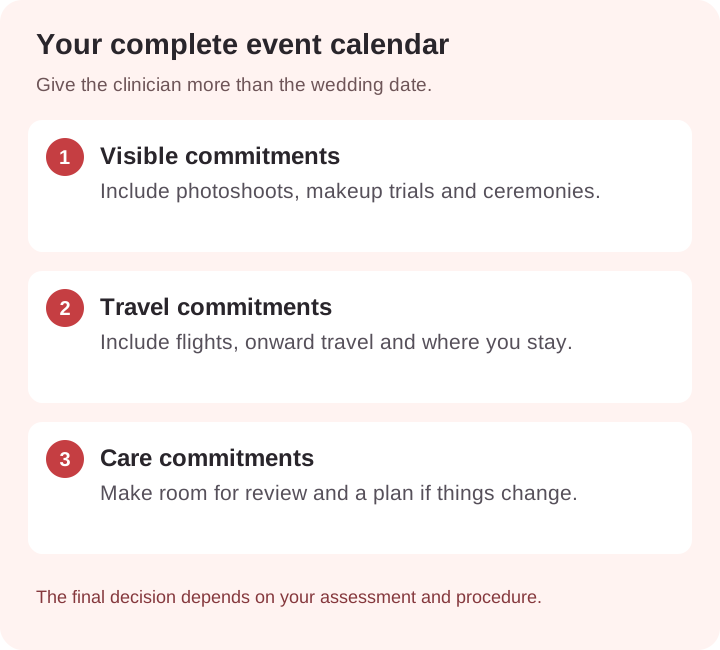
Bring the full event calendar. An engagement shoot, makeup trial, family ceremony and wedding may have different dates. Add flights, work obligations and any destination honeymoon. Explain which commitments cannot move. A clinician can only help you compare the practical risks when they know the real deadline. Decide in advance how you would feel about visible bruising, peeling or an uncertain result during those commitments, rather than making that decision after treatment.
Separate ongoing skin disease from cosmetic finishing touches
Active acne, persistent redness or a recurrent rash deserve an appropriate assessment. They are not automatically problems for a stronger facial or a last-minute laser. Ask what is causing the concern and whether ordinary medical treatment should come first. A successful plan may prioritize controlling a condition rather than changing skin texture before a photograph. For persistent acne, our acne treatment guide explains why active breakouts and old scars are different treatment targets.
Acne treatment takes time. The American Academy of Dermatology advises that fewer breakouts may take at least six to eight weeks to become apparent. This is not a guarantee of clear skin by week eight. It is a reason to seek assessment early and avoid expecting an appointment shortly before a wedding to replace a course of care. If you already have a treatment plan, ask your prescribing clinician how travel and any proposed cosmetic procedure fit around it.
Think in planning stages, not a universal countdown
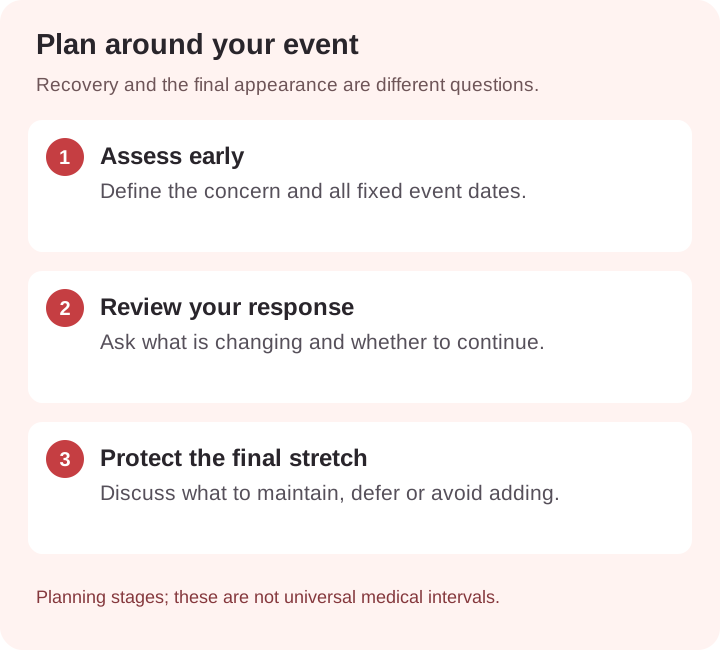
When the event is still distant, there is more opportunity to identify the problem, discuss alternatives and observe your response. Use that time to establish what you actually need. If a procedure involves a series, ask what benefit is realistic within the available period and how the doctor will decide whether to continue. Do not purchase multiple sessions merely because a package expires before the wedding.
As the event gets closer, ask the clinician to review the remaining benefit against the uncertainty of introducing something new. A procedure that was a reasonable possibility earlier may no longer fit. In the final stretch, discuss whether maintaining a familiar routine is preferable to adding a new intervention. These stages describe a decision process, not a prescribed number of weeks. The appropriate stopping point depends on the treatment, your response and the importance of avoiding visible change near the event.
A first treatment is a different planning problem
If you have never had a proposed procedure, you have less personal information about the experience and recovery. Even a treatment you have had previously is not a guarantee: a different product, anatomical area or treatment intensity may change the situation. Tell the clinician precisely what you had before and how you reacted. “I have had a facial” is not equivalent to documenting a previous peel, injection or laser session.
Ask what could happen if the response is less predictable than expected. Would there be enough time for examination and appropriate management? Who would see you if you were already at the wedding destination? The purpose is not to imagine every possible complication. It is to understand whether your calendar has room for the ordinary uncertainty of medical care. If it does not, declining a first procedure can be a thoughtful choice rather than a missed opportunity.
Understand the difference between treatment and result timing
A treatment appointment can be brief while its visible effects evolve afterward. Botulinum toxin, for example, affects muscle activity rather than adding volume. Bruising, swelling or an unwanted effect on nearby muscles can matter around an event even when the procedure does not require an extended stay at home. The AAD’s botulinum toxin information describes these possibilities. Ask when your doctor intends to assess the response rather than deciding from the appointment duration alone.
Peels provide another example. The depth of a peel changes its recovery requirements substantially; a light peel and a deep peel do not belong in one generic “facial downtime” category. The AAD’s peel guidance distinguishes their healing and follow-up needs. Ask which specific peel is proposed, what visible changes to expect and when cosmetics can be used. Do not take “lunchtime” or “refreshing” as a guarantee that no redness or scaling will occur.
Avoid buying a new skincare routine at the same time
A trip to Korea can make it tempting to try several new cleansers, masks, exfoliants and active products together. That can make a reaction harder to interpret. Keep a list or photographs of what you use and show it during the consultation. Ask which products should remain part of the plan and which should be discussed before a procedure. Prescription changes belong with the prescribing clinician, not a shopping recommendation.
The AAD recommends testing new skincare products before broader use and notes that ingredients can cause irritation or allergic contact dermatitis. Its product-testing guidance concerns topical products; it is not a way to test whether an injection or medical procedure is safe. For event planning, the practical lesson is to avoid treating a newly purchased product as a risk-free finishing step. A familiar, tolerated routine can be more useful than a crowded bag of unfamiliar products.
Coordinate makeup, grooming and aftercare
Tell the clinic about scheduled makeup trials, facials, waxing, massage and other grooming appointments. Ask whether any should be moved in relation to your specific treatment. Get instructions that name the activities rather than relying on “resume normal life.” Your normal life may include prolonged outdoor photography, stage lighting, vigorous exercise or travel, none of which a generic phrase explains. Clarify which restrictions are about comfort, healing or the treatment result.
Share relevant aftercare limits with your makeup artist without feeling obliged to disclose your full medical history. Ask the clinician what should happen if your skin becomes irritated before the event and which contact route is monitored. Makeup is not a substitute for assessing a concerning symptom. If you are uncertain whether a reaction is expected, seek clinical advice rather than adding more products to conceal it. The goal is to protect your skin, not simply to make a photograph possible.
Build a travel plan that allows a real review
A review appointment has value only if you can attend it and act on its advice. Before committing to treatment, compare the proposed review date with your flight, ceremony and onward travel. Ask whether you need to remain nearby and whether a remote review would be adequate for the particular situation. Do not assume a photograph can replace an examination when a problem develops. Agree on how records can be shared with a clinician at home if necessary.
For a wedding abroad, think beyond the return to your own country. You may travel from Seoul directly to another destination. Write down where you will actually be during the recovery period and how to obtain care there. If an appropriate follow-up arrangement is not practical, discuss whether the procedure should wait. Our visit-planning guide can help organize the consultation and recovery commitments without turning the trip into a fixed medical itinerary before assessment.
Budget for the decision, not just the procedure
Ask for the price of assessment and the recommended core treatment separately from optional additions. Include follow-up and any necessary aftercare in the comparison. Clarify what happens to a deposit if the doctor advises against treatment because of the event date or an examination finding. A discount has little value if it encourages an intervention that does not fit your priorities. You should be able to accept a consultation without accepting every proposed procedure.
Set a personal limit on uncertainty as well as spending. For example, you may decide that a small possible cosmetic gain is not worth altering a nonmovable event. That is a preference to communicate, not a medical rule for everyone. Tell the clinician whether the priority is making a change or avoiding a visible disruption. Those are both legitimate goals, and the answer can influence whether treatment is appropriate at all.
Recommended listed clinics to discuss an event-focused plan
The clinics below are commercial partners selected for relevant skin-care and aesthetic services on their current official websites. They are consultation options, not a ranking or a guarantee of readiness for your event. The consultation should establish whether any intervention fits your skin and calendar.
Beauty Story Clinic lists medical skincare and injectables and describes individualized appointments on its international website. This makes it relevant for discussing whether a skin-quality concern calls for treatment now, later or not at all. Bring the event dates and ask the clinician to identify the smallest useful plan. Confirm appointment arrangements directly rather than assuming the website’s scheduling description guarantees a particular slot or clinician.
BLS Clinic Main Branch lists skin care and laser services, including a laser-treatment service page. It is relevant when pigmentation or texture is part of the pre-event conversation. Ask for a diagnosis before requesting a device and explain how much visible recovery you are prepared to accept. Review the international clinic website and request an assessment of timing; availability of a treatment does not mean it is suitable close to a wedding.
Questions patients often ask
Can I have a new treatment one week before the event? The date alone cannot establish suitability. Ask about the exact procedure, likely visible effects, important risks and the ability to arrange review. If there is no room for an unexpected response, a consultation and a familiar routine may fit your priorities better than a first procedure.
Should I combine several treatments to save time? Do not use the event as a reason to compress decisions. Every component needs its own purpose and risk discussion, and the combination needs assessment. Read our guide to combining treatments before purchasing a bundled appointment.
What if I already booked something that now feels too close? Contact the treating clinic and explain the full calendar. Ask for clinical reassessment and the options for deferral or consultation only. Do not proceed solely because a deposit has been paid. Making a decision you can live with matters more than completing the original booking.